FORGOTTEN GAMER TECH OF THE 90'S

> THE YEAR OF THE BEAST
The year was 1993. The Beastie Boys were dominating the charts with their distorted grit, teenagers everywhere were inexplicably wearing their pants backwards, and Coca-Cola was trying to capture Gen X apathy in a gray can called OK Soda.
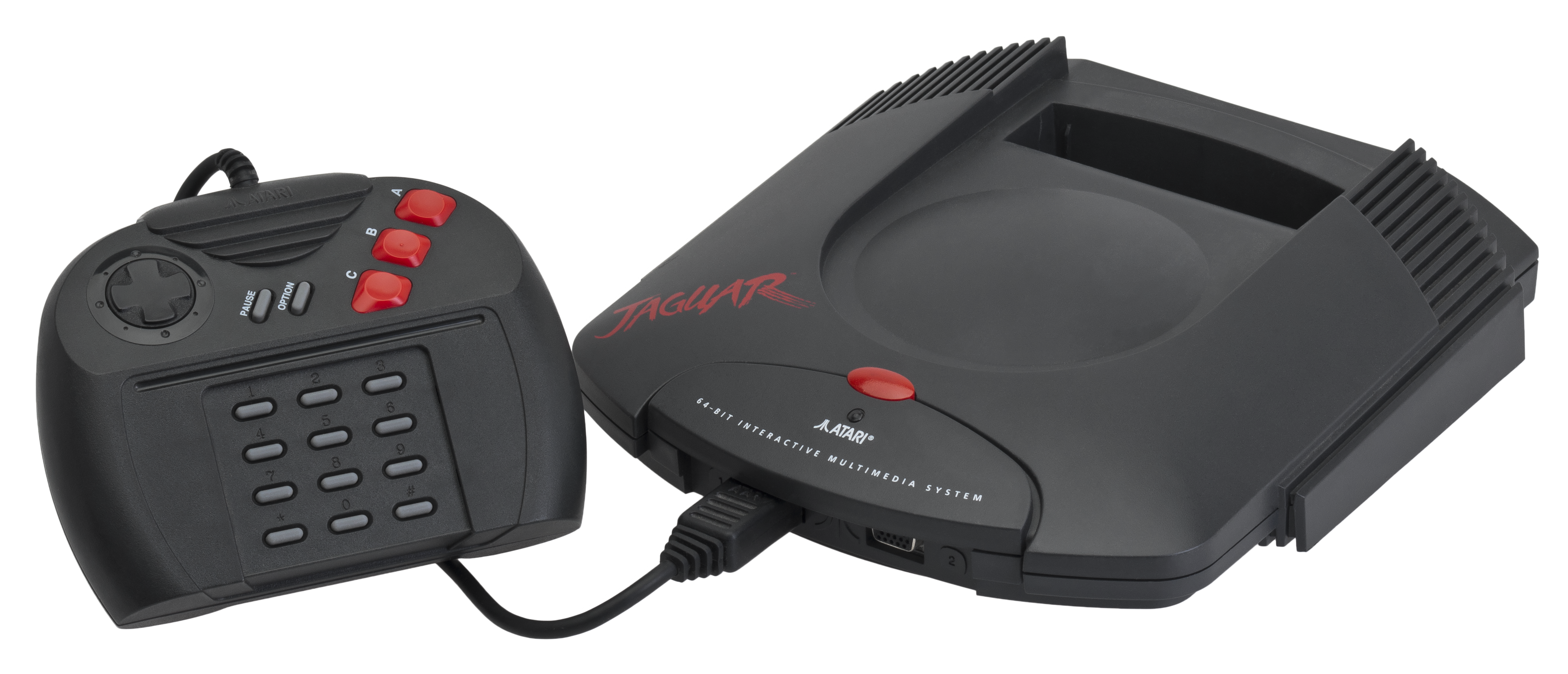
It was a bizarre, experimental era of transition. While the rest of the world was still wrestling with 16-bit sprites, Atari decided to skip a generation and drop a thermonuclear device on the console wars: THE ATARI JAGUAR.
If you want to know what the Jaguar was truly capable of when the chips were down, look no further than Alien versus Predator. Even today, the atmosphere in that game is suffocating.
Creeping through the dark, metallic corridors of a Colonial Marine base while the motion tracker clicks in your ear wasn't just gaming—it was a survival horror masterclass.
It remains one of the few titles that proved the Jaguar’s complex "Tom" and "Jerry" processors could deliver an experience that left the competition looking like Saturday morning cartoons.
// INTERCEPTED_MEDIA: ARCHIVAL_FOOTAGE // SOURCE: ATARI_AGE_ARCHIVES
> SEGA CHANNEL
- LAUNCH:December 1994
- COST:~$14.95 / Month
- SPEED:6 Mbit/s Data Rate
- LIBRARY:50 Rotating Titles
- TECH:Coaxial Cable

> CRYSTAL BLUE PERSUASION
If the Jaguar was the pinnacle of 90s hardware ambition, the Sega Channel was pure 90s sorcery.
Long before "Cloud Gaming" was a corporate buzzword and decades before Game Pass became a household name, Sega was delivering a rotating library of titles over cable lines.
It felt like a fever dream—plugging a massive, glowing cartridge into your Genesis, waiting for the progress bar to fill, and suddenly having access to Mega Turrican or Street Fighter II without ever leaving the house.

It was the ultimate "Best in Tech" flex: a subscription service that turned your coaxial cable into a digital arcade.
For a brief moment in the mid-90s, the future wasn't something you bought on a shelf; it was something that streamed through the walls.

> Tethered SOULS
The Panasonic FZ-10 R.E.A.L 3DO was much more than just a slimmer revision; it was a high-stakes play to win its place in living rooms across the land.
While Sega CD was essentially a bolt-on for an aging 16 bit console, the FZ-10 brought true 32-bit power and specialized video co-processors to the table.
The most radical legacy the 3DO left for modern gaming was its unique "Daisy-Chain" multiplayer architecture.
Rather than having a set number of ports on the front of the machine, the controllers themselves featured a port on the back.
You would plug the first controller into the console, the second into the first, and so on, supporting up to eight players without ever needing a separate adapter.
// INTERCEPTED_MEDIA: 3DO_DAISY_CHAIN_DEMO

> THE UNTETHERED SAVAGE
The Sega Neomad was basically a piece of high-end alien technology that arrived five years too early. While the Game Boy was still rocking a four-shade pea-soup screen, Sega handed us a literal handheld Genesis. It didn't "approximate" the home experience; it played the exact same cartridges you had in your living room.
Holding a Nomad felt like holding a brick of pure 16-bit power, even if that power meant you were tethered to a wall outlet after only ninety minutes of battery life.
What really made the Nomad a savage was that second controller port. It wasn't just a handheld; it was a portable console that could output to a TV, effectively acting as a primary system for anyone on the move.
It represents that peak Sega era of "more is more," where they were willing to sacrifice your wrist health and your parent's battery budget just to prove that 16-bit gaming didn't need a couch to be legendary.
The Motorola 68000 inside this thing was doing heavy lifting that no other portable could touch in 1995.
Even though it was a commercial failure at the time, the Nomad set the blueprint for the "hybrid console" concept decades before the Switch made it mainstream. It was bulky, it was thirsty for AAs, and it was glorious.

> THE MACINTOSH MULTIPLAYER
The Apple Bandai Pippin remains one of the most fascinating "what if" scenarios of the 1990s—a bizarre hybrid that tried to bridge the gap between a home computer and a gaming console long before that was a standard concept.
Launched in 1996, the system was essentially a stripped-down Macintosh running a version of System 7.5.2, designed to give users a "cheap" entry point into the world of CD-ROM multimedia and the burgeoning internet.
While giants like Sony and Sega were fighting a war over 3D polygons, Apple took a different route by licensing the technology to Bandai. They hoped to create an ecosystem of set-top boxes that could do more than just play games.
It featured a PowerPC 603 processor and a unique "Boomerang" controller with a built-in trackball, making it feel more like a web-browsing workstation for your living room than a dedicated arcade machine.
The problem was that the 90s market wasn't ready for a $600 console that lacked a "killer app" to justify the price tag.
With the PlayStation retailing for significantly less and offering a massive library of hits, the Pippin struggled to find its identity.
It was a machine caught between two worlds: too expensive for a toy, yet not powerful enough to replace a desktop Mac, eventually leading to its cancellation shortly after Steve Jobs returned to Apple in 1997.

> THE DREAM KILLER
The Sega Dreamcast was a console born of desperation and brilliant engineering.
Arriving in 1999, it was supposed to be the machine that saved Sega, but instead, it became the industry's most beautiful "Dream Killer."
What truly set the Dreamcast apart was its forward-thinking DNA. Every unit shipped with a 56k modem built right in, making online gaming accessible to the masses through the SegaNet service.
Despite its innovations—like the Visual Memory Unit (VMU) that put a second screen in your hands—the shadow of the PlayStation 2 proved too large.
A combination of rampant piracy via its GD-ROM drive and Sony's massive marketing machine eventually forced Sega out of the hardware business forever.
It died young, leaving behind a legacy as the most ambitious, "ahead of its time" underdog in gaming history.
These quirky machines will always have a special place in my heart. What was your favorite piece of forgotten tech from the past?


